
How Do You Know You’re Present?
The paradox at the heart of inner work

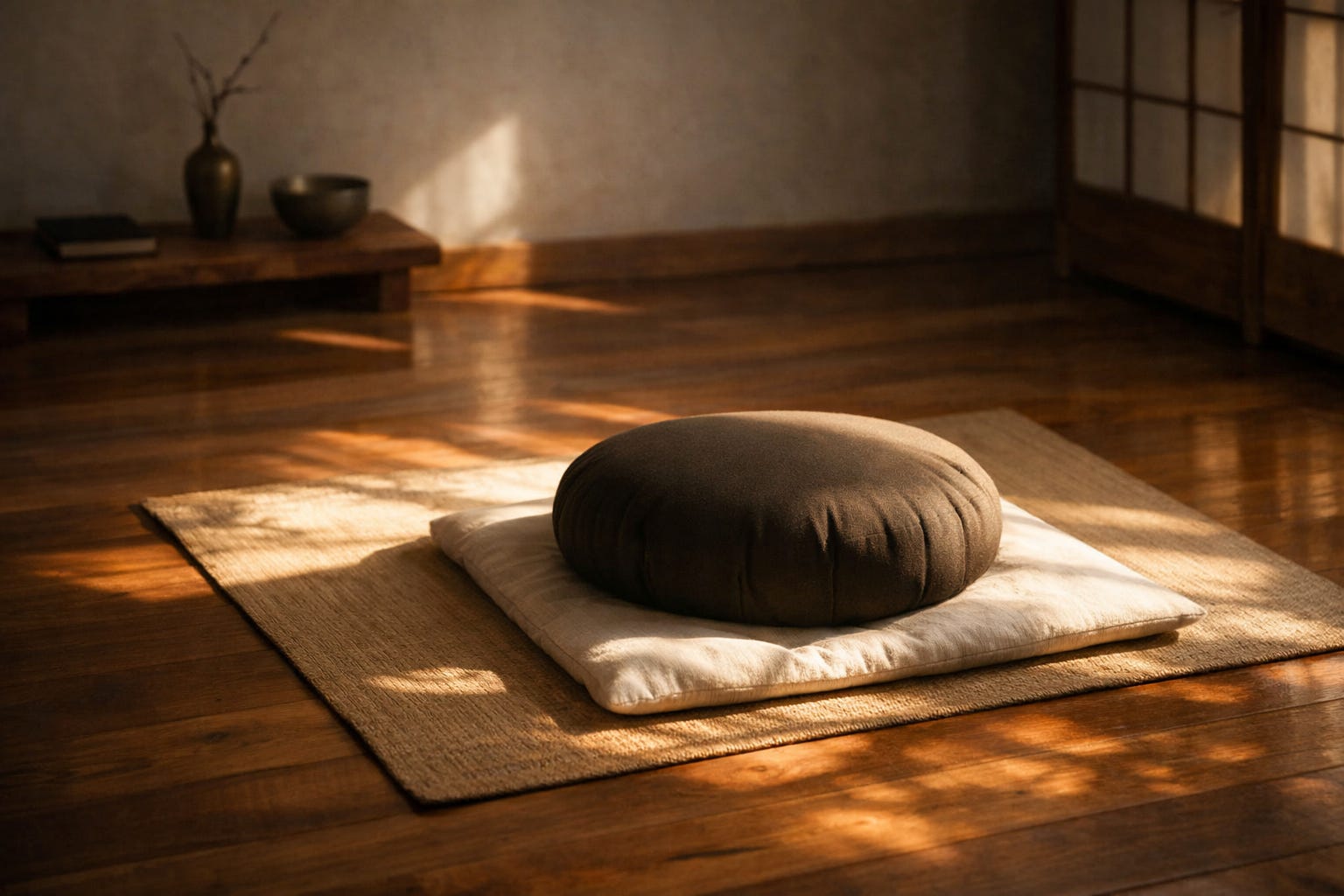
I’ve been meditating for decades. Thousands of hours on the cushion. And there’s a question I’ve been struggling with for a long time — one that doesn’t get easier with practice:
How do I actually know how present I’m being right now?
Not as a philosophical exercise. As a genuine problem that I still don’t have a clean answer to.
The Catch-22
Here’s the thing about presence: the capacity you’re trying to assess is the same capacity doing the assessing.
Think about it. An alcoholic doesn’t know they’re drunk — not really. A dementia patient doesn’t know they’re confused. Someone in a dissociative state often feels calm and centered, more “present” than usual, while actually being checked out.
So when I sit here feeling present, feeling aware, feeling like I’m really here — how do I know that’s accurate?
I don’t. Not with certainty.
And the weird part is: the longer I practice, the clearer this uncertainty becomes.
This Isn’t False Modesty
I’m not performing humility here. I’m not saying “oh, I’m so bad at this” to seem relatable.
I’m pointing at something structural.
The more skilled you become at accessing presence, the more clearly you see how uncertain that access actually is. It’s not that practice makes you worse — it’s that practice strips away the naive confidence that you’ve got this figured out.
The beginner thinks: I’m present when I feel present.
The intermediate thinks: I’m getting better at this. I can feel the difference.
The experienced practitioner thinks: I genuinely don’t know how present I am right now. And that might be the most accurate thing I can say.
Holding It Like a Baby Bird
So what do you do with this uncertainty?
You can’t grip it. If you start obsessing over whether you’re really present, that very obsession pulls you out of whatever presence you had.
But you can’t ignore it either. Pretending you have certainty you don’t have is its own kind of leaving.
The image that came to me in meditation one morning: hold it like a baby bird still finding its way out of its egg.
Gentle. Present. Acknowledging its fragility without crushing it with attention.
The uncertainty lives in the background — noted but not gripped. You keep practicing anyway. You just stop claiming certainty you don’t have.
What This Has to Do with Death
Here’s where it gets interesting.
This uncertainty about presence has the same structure as our uncertainty about death.
We cannot know what the experience of dying will be like. We cannot know what our minds will do as we approach our last breath — what combination of terror, denial, bargaining, peace, or confusion will arise. We cannot know if we’ll be present for our own death or if we’ll check out before the end.
And there’s no way to practice dying in advance to find out.
So we’re left with the same posture: holding uncertainty gently. Staying engaged anyway. Trusting that not-knowing doesn’t preclude meaningful living.
The person who can sit with “I don’t know how present I’m being right now” is practicing for death. Not in a morbid way. In a truthful way. Both require releasing the illusion of certainty while remaining oriented.
The Fumbling Is the Work
There’s a framework that describes four stages of competence:
Asleep — You don’t know what you don’t know
Waking — You start to see your own limitations
Practicing — You’re learning, consciously working at it
Embodied — It becomes automatic, you don’t have to think about it
Most people assume the goal is Embodied. Mastery. Flow. It becomes automatic.
But there’s a trap in that framing.
Embodied can become assumed Embodied. “I’ve got this” might be the most dangerous thought a practitioner can have. The feeling of mastery can mask continued gaps.
What if Waking — seeing your own limitations — is actually closer to enlightenment than anything?
The fumbling is not the obstacle to presence. It might be the door.
The person who knows they’re fumbling is more accurate than the person who thinks they’ve arrived.
I asked a remarkable medical scientist once how much all of science and humanity knows about the human body. He said maybe two or three percent.
We don’t know much. And knowing that we don’t know — really sitting in that not-knowing — might be the most honest and useful posture available.
What This Means for Daily Life
A practical question: if I can’t even be certain I’m present during meditation, how do I move into my day? How do I do my taxes? How do I engage with the endless demands of ordinary life without losing this awareness?
The answer, I think, is that the question contains a false assumption.
We imagine there’s a “more evolved” state that transcends taxes. That the monk under the tree is somehow more present than the householder navigating spreadsheets.
But presence isn’t about the activity. It’s about the quality of attention brought to the activity.
Can I bring the same humble uncertainty to doing taxes that I bring to meditation?
Not performing humility while doing taxes. But actually holding “I don’t know how present I’m being right now” while navigating numbers and forms.
The fumbling continues. The uncertainty doesn’t resolve. And that’s not a problem to fix — it’s the actual shape of the path.
The Invitation
If any of this lands for you, here’s something worth trying:
Notice the next time you feel confident about your own awareness. Not suspicious of it — just curious. How do I actually know?
Hold that question gently. Like a baby bird.
And keep practicing anyway.
The Unveiling Self Assessment looks at how your relationship to presence — your capacity to stay with yourself, with others, and with what’s real — shows up across all three dimensions of your life.
It’s free, it’s private, and most people sit with their results for days.
New here? How to Read This Substack — three doors in, depending on where you’re starting.